From Overseas Client Payments to INR: A Stablecoin Payment Flow for Indian Businesses
One way an Indian business could take dollar and euro payments from overseas clients, hold them as stablecoins, and turn them into rupees — what each step costs, what to keep on file, and what to confirm with your bank and CA before you rely on it.
If you run an agency, a software consultancy or a freelance practice in India with clients in the US or Europe, you already know the question that matters is not what the invoice said but what reached your bank. Between the two sit a conversion rate, a correspondent or receiving charge, and sometimes a few days of not knowing. Many banks and payment providers handle this well; the point of this article is not that they are expensive, but that the net figure is worth comparing, and that there is another route some businesses are looking at.
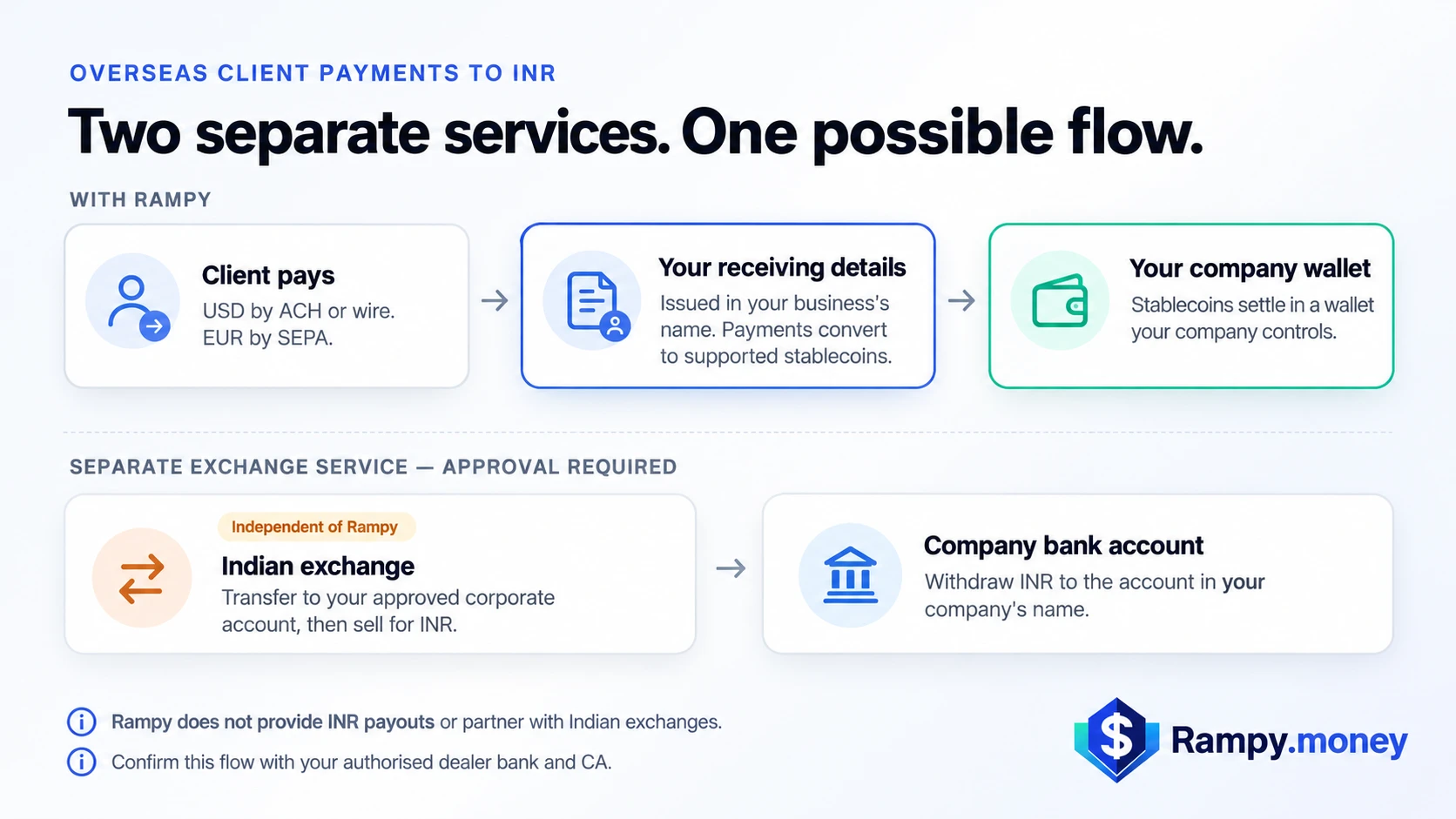
That route uses stablecoins in the middle: your client pays an ordinary bank transfer, it arrives with you as a stablecoin, and you later sell it for rupees. Rampy handles the first half. The second half is a separate service you choose and are approved for yourself.
The flow, step by step
- Your overseas client pays USD by ACH or wire, or EUR by SEPA, the way they pay any supplier.
- The payment lands in receiving details issued for your business through Rampy, and is converted into a supported stablecoin.
- The stablecoins settle in your business's own wallet — one your company controls, not an account Rampy holds for you.
- When you want rupees, your business transfers supported assets to its own corporate account at an Indian exchange, on a network that exchange accepts.
- You sell for INR on that exchange.
- The exchange withdraws the rupees to your company's registered bank account.
Steps 1 to 3 happen with Rampy. Steps 4 to 6 happen on an exchange account your business holds separately, as the picture at the top of this page shows.
Receiving USD and EUR
A verified business can open receiving details in US dollars and euros. US dollar details are a US account and routing number that take ACH and wire; euro details are an IBAN that takes SEPA. Both are issued in your business's name by our regulated payments partner. They are receiving details for this purpose, not a standalone bank account: there is no balance held for you, no cards or overdraft, and nothing in them should be read as deposit insurance — anything paid in is converted and sent on.
Each payment in costs 1.99% of the amount, with no flat fee. Your own business accounts can pay in any amount. A registered business client can pay you in either currency; payments from private individuals are limited by rail — under $4,000 per payment in US dollars, and not enabled by default in euros. New accounts are reviewed before their details are issued.
Eligibility is decided by our partner during verification. India is a supported country in its medium-risk tier, which means verification goes ahead with the usual checks; it does not mean every business is approved.
Sources: Bridge: virtual accounts · Bridge: supported countries · Who can pay into a deposit account
What arrives in your wallet
Which stablecoin and network you receive depends on the route, and you choose it when you open the details. US dollar payments can arrive as USDC on several networks, or as USDT on Ethereum, Solana or Tron. Euro payments arrive as USDC or EURC — not as USDT. If the exchange you will sell on only has an INR market for a coin you did not receive, you can swap first, for 0.5% with no flat fee, or open your details in the coin the exchange takes.
The wallet is yours. Rampy never holds your coins, which also means a wrong address or network when you send them on cannot be reversed by anyone.
Selling for INR: an independent exchange
Rampy does not pay out in rupees and has no partnership or integration with any Indian exchange. The exchange stage is a relationship your business has directly, and the exchanges below are simply options to investigate:
- ZebPay publishes a corporate account process: incorporation documents, a board resolution, IDs of directors and beneficial owners, proof of business, financials showing source of funds, and a cancelled cheque for the company bank account.
- Giottus's AML policy onboards entities incorporated in India, verifies the entity's PAN, signatories and beneficial owners, and may ask for evidence of source of funds at any time.
- CoinDCX accepts a business bank account only on an Enterprise account, and only a current account in the business's name.
- CoinSwitch lists an institutional offering with an enquiry form; its page does not set out which entity types it onboards.
Sources: ZebPay: corporate accounts · Giottus: AML policy · CoinDCX: enterprise bank accounts · CoinSwitch: institutional
What it really costs
A USDT/INR price on a screen is the last trade or the best quote at that moment, not the price your whole order will fill at. To compare this route with your bank's, work out the rupees that actually reach your company account, after every step:
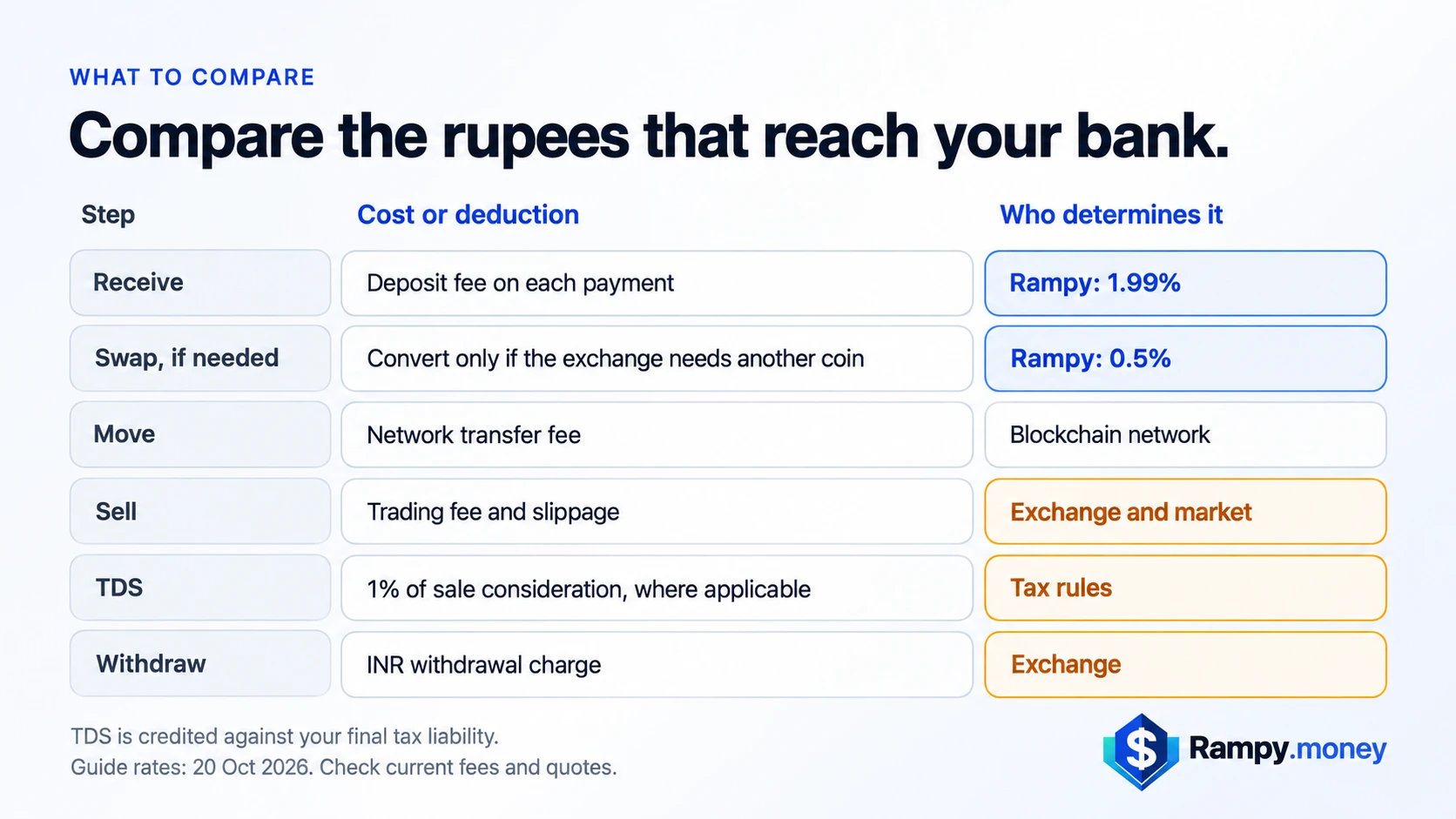
An illustration at prices seen on 20 October 2026
Stablecoins have traded at a premium to the dollar on Indian exchanges. When this was written, the ECB reference rate was ₹94.93 per US dollar, while USDT's best bid was ₹101.24 on CoinDCX and ₹100.33 on WazirX — 5.7% to 6.6% above it. The premium reflects local supply and demand, moves every day, and can narrow or disappear: treat it as something to check on the day, not something to plan around.
The illustration below uses a fill of ₹100.30 per USDT, a little under both best bids, because an order of this size works down the order book. Every other figure is an assumption, stated.
| Step | Assumption | Amount |
|---|---|---|
| Client pays | $10,000 by ACH | $10,000.00 |
| Rampy deposit fee | 1.99%, arriving as USDT on Tron, so no swap | −$199.00 → 9,801.00 USDT |
| Network fee to the exchange | Assumed 1 USDT | 9,800.00 USDT |
| Sell for INR | Assumed fill of ₹100.30 per USDT | ₹982,940.00 |
| Exchange trading fee | Assumed 0.20% | −₹1,965.88 |
| TDS withheld | 1% of the sale value | −₹9,829.40 |
| INR withdrawal charge | Assumed nil; check yours | ₹0.00 |
| Credited to your bank | ₹971,144.72 | |
| For comparison | $10,000 at the ₹94.93 reference rate, before any bank margin or charges | ₹949,300.00 |
On those prices the stablecoin route credits about ₹21,800 (2.3%) more than the reference rate would, even with the TDS withheld — and more again against a bank rate that includes a margin. But the comparison is only as good as the day's premium, and two things can change it: the TDS line is cash withheld at the time of sale, not your final tax, so it is credited against what you owe; and if any of the premium counts as a gain on a virtual digital asset, that gain is taxed at 30%. How the income is assessed is the subject of the next section.
Sources: ECB: euro reference rates (USD and INR) · CoinDCX: USDT/INR market · WazirX: USDT/INR market
Sources: Income Tax Department: virtual digital assets · Giottus: selling for INR
What you need in place
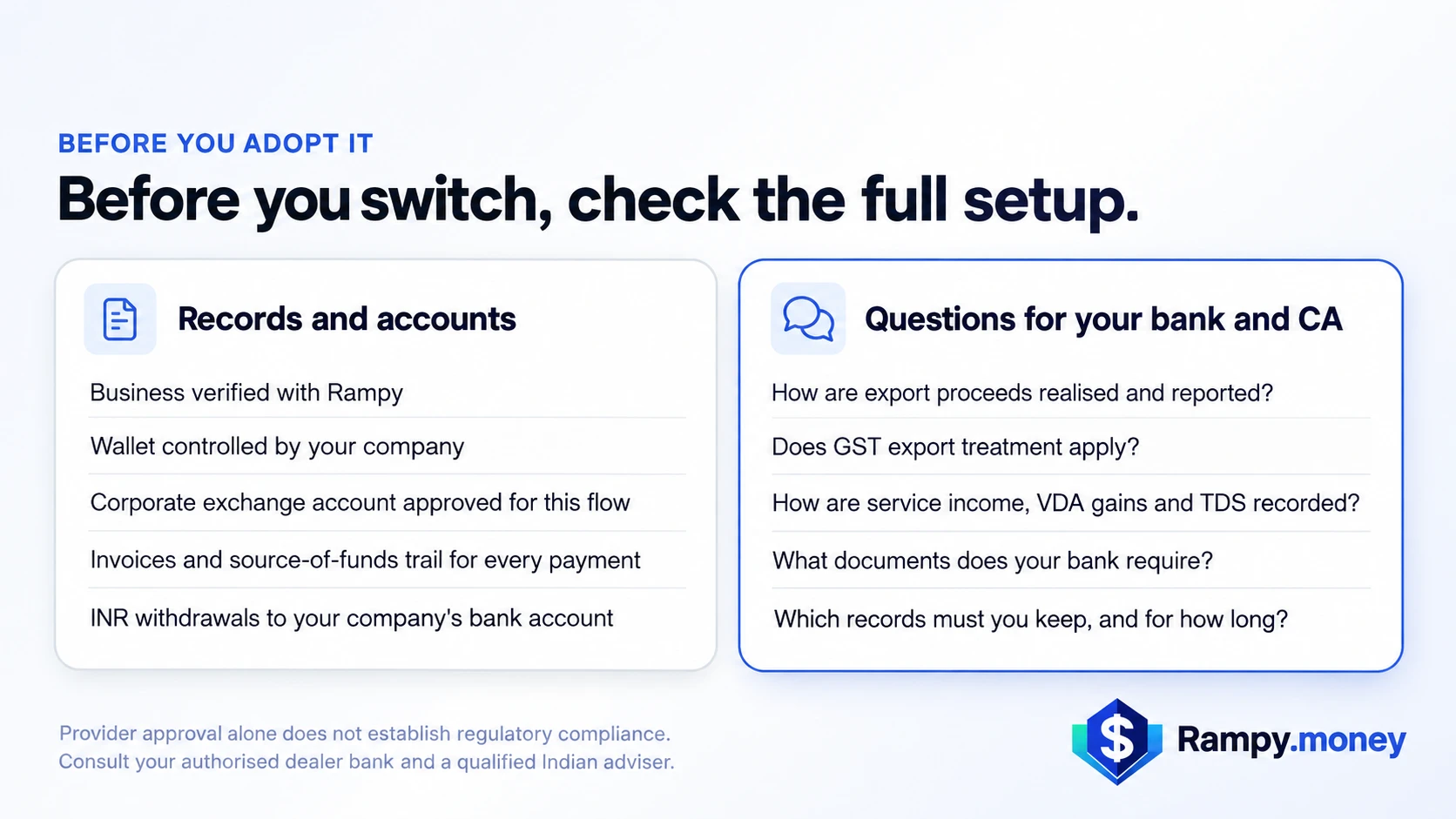
- Your company verified with Rampy, with the same legal name and details your bank and exchange hold.
- A wallet your company controls, recorded as the company's, with who can approve transfers from it.
- The exact token and network your exchange accepts for deposits and has an INR market for.
- An invoice for every payment received, so each deposit can be matched to a client and a service.
- Source-of-funds records the exchange can follow from client invoice to receiving details to wallet to deposit.
- An INR withdrawal account in the company's own name, matching the exchange's records.
India: confirm before you adopt it
Being approved by Rampy, or by an exchange, does not establish that this structure meets India's foreign-exchange, reporting or tax requirements for export income. Three questions in particular are worth putting to your authorised dealer bank and a qualified Indian adviser before you change how clients pay you:
- Realisation and reporting. Indian rules set out how export proceeds are to be realised and reported, normally through an authorised dealer bank and its documentation. Ask whether proceeds that arrive as stablecoins and are sold on an Indian exchange meet those requirements for your business.
- GST. An export of services is zero-rated only where, among other conditions, payment is received in convertible foreign exchange, or in rupees where the RBI permits. Ask whether rupees from an exchange sale satisfy that condition in your case.
- Income tax. Stablecoins are treated as virtual digital assets: transfers carry 1% TDS, and income from transferring them is taxed at 30%. Ask how your service income and any gain or loss on the stablecoins are each to be accounted for.
Sources: CBIC Circular 202/14/2023 (export of services, payment condition) · Income Tax Department: virtual digital assets
Receiving payment as stablecoins does not remove any reporting obligation, and Rampy cannot tell you this flow is right for your business. If your advisers are comfortable, it is one option to compare; if not, a conventional inward remittance remains the reference point.
Explore business payment options with Rampy.
Rampy for businessesFrequently asked
Does Rampy pay out in Indian rupees?
No. Rampy delivers stablecoins to your own wallet. Selling them for INR happens on an exchange account your business holds separately.
Are the USD and EUR details a bank account?
They are receiving details in your business's name, issued through our regulated payments partner, that accept ACH and wire or SEPA payments and convert them on arrival. They do not hold a balance and should not be treated as an insured bank account.
Will my payment arrive as USDT?
US dollar payments can arrive as USDT on Ethereum, Solana or Tron if you choose that when opening your details. Euro payments arrive as USDC or EURC, not USDT; you can swap if your exchange needs a different coin.
Can freelancers use this, or only companies?
Both individuals and businesses can be verified with Rampy. On the exchange side, availability differs: some Indian exchanges offer business accounts only for registered entities, and individuals open personal accounts with different requirements. Check with the exchange.
Is the 1% TDS my tax?
No. It is withheld when you sell and credited against your final liability, which depends on how your income is assessed. Ask your CA.
Is this approved by the RBI?
No regulator has approved this flow, and Rampy does not claim it suits any particular business. Confirm it with your authorised dealer bank and advisers before using it.